

بسم الله الرحمن الرحیم
In the name of Allah, the most compassionate and the most merciful
الحمدلله الذي نصر عبده، و أعز جنده، و هزم الأحزاب وحده. لا اله الا الله وحده لا شریکه له، له الملک و له الحمد، و هو علی کل شيئ قدیر.
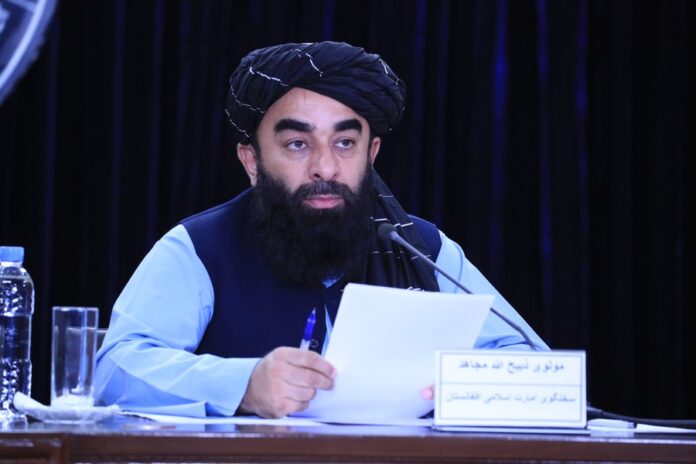
Today, I want to provide a series of clarifications and observations concerning the security of all official borders and the notional demarcation line, the overall security situation in Afghanistan, and certain movements of sedition and corruption operating near that line.
The situation across all of Afghanistan’s official borders and along the notional demarcation line remains fully under control. Illegal activities have been largely curtailed. The Ministry of National Defense of the Islamic Emirate of Afghanistan continues to employ all available resources to further strengthen operational oversight and protection of these areas. Recently, the Ministry has undertaken a number of measures in pursuit of these objectives.
Overall, the security situation throughout Afghanistan is stable. There are no significant threats across the country’s geography. Over the past eight months, no major political or security incidents have occurred. Those previous attacks—both large and small—originating from centers of sedition and corruption beyond Afghanistan’s borders have been decisively neutralized; their perpetrators have been apprehended or eliminated, by the grace of Allah.
In recent weeks, certain ill-intentioned elements have attempted to create confusion among the Afghan public by spreading rumors and propaganda aimed at sowing anxiety and distrust. The faithful people of Afghanistan are urged to remain calm and not give credence to such rumors. The Islamic Emirate of Afghanistan maintains constructive engagement and mutual understanding with regional and global partners, guided by Islamic Sharia and our national interests. Dialogue remains our preferred mechanism for resolving challenges, and notable progress has been achieved in this regard. It is now clearly understood that Afghanistan’s stability and security are essential to the stability and security of the entire region and the broader world.
Regrettably, it appears that certain specific circles in Afghanistan’s neighborhood are displeased by the improved security conditions and Afghanistan’s progress in the political, economic, and social spheres. These elements have consequently embarked on various conspiratorial activities.
This particular circle is a dominant group within Pakistan’s military. Based on our information, the majority of Pakistan’s military officers, politicians, political parties, religious scholars, and devout citizens do not agree with their anti-Afghanistan policies; even they themselves have suffered from the arbitrary and authoritarian conduct of this dominant faction. In its campaign to create unrest in Afghanistan, this faction has undertaken several actions, including:
1. Conducting propaganda against Afghanistan and the Islamic Emirate on international platforms, spreading false narratives and negative perceptions.
2. Producing fabricated information and disseminating it through deceptive channels designed to mislead the international community. Such disinformation—often aimed at portraying Afghanistan as insecure—has become a commercial enterprise. The main goal of these fabricated reports is to create security concerns about Afghanistan; an activity that has now evolved into a commercial business for them.
3. Attempting to widen divisions and hostility between the faithful people of Afghanistan and Pakistan by tarnishing the image of the Islamic Emirate among Pakistan’s devout citizens. They seek to shift blame for Pakistan’s internal security challenges—caused by their own misguided policies—onto Afghanistan, thereby concealing their failures. They have consistently sabotaged all logical and reasonable efforts to resolve Pakistan’s security issues, instead advancing a self-serving agenda that perpetuates regional instability and conflict. It should also be noted that the tribal refugees currently residing in Afghanistan had migrated there before the establishment of the Islamic Emirate’s rule. The cause of their migration was precisely the misguided policies and violent operations of this same circle in the tribal areas. The Islamic Emirate will warmly welcome every sincere effort and initiative that results in the return of these refugees to their native regions.
4. Attempting to foment divisions among the people of Afghanistan, seeking to lure certain individuals into their trap and use them against Afghanistan’s national security. Their objective is to influence these individuals by instilling misguided notions and a false sense of purpose.
5. Inciting tensions along the demarcation line, violating Afghanistan’s airspace, and conducting airstrikes near civilian areas at a time when Afghanistan is making notable political and economic progress. Each such violation has received a decisive and proportionate response. It must be clearly understood that Afghanistan reserves the sovereign right to defend its land and airspace and will not leave any aggression unanswered.
6. Ignoring the presence and activities of ISIS (Daesh) within their own territory—allowing a project that endangers their own religious scholars and citizens, while also threatening the security of Afghanistan and the world. When Afghanistan was under occupation, the emergence of ISIS in the eastern provinces originated from across the line, in the Orokzai region. The group was initially led by a Pakistani national named Saeed Khan and included hundreds of recruits from across Pakistan’s provinces. The Mujahideen of the Islamic Emirate fought this seditionist group—created to defame Islam and Jihad—even while engaged against the occupying forces. Following the liberation of the country, the Islamic Emirate continued this struggle with determination until the group was dismantled and Afghanistan’s territory was cleared of its presence. The remaining members of the group fled to Khyber Pakhtunkhwa and Balochistan, where they established new hideouts and began recruiting from various countries. Recruits were transferred through Pakistan’s western borders and via the airports of Karachi and Islamabad to these centers, where they received indoctrination and training in extremist ideology and violent tactics.
According to reliable intelligence and corroborated evidence, the attack at the martyrdom anniversary of Sardar Soleimani in Tehran and the attack in Moscow; were planned, organized and carried out from these same centers. The relevant countries are aware of this reality.
Similarly, numerous deadly attacks inside Afghanistan targeting religious scholars, officials of the Islamic Emirate, Mujahideen, and civilians were orchestrated from these centers. Attackers and organizers were dispatched from these centers into Afghanistan. The Islamic Emirate possesses sufficient evidence and documentation substantiating these claims.
For instance: attacks in Kabul on Sheikh Rahimullah Haqqani (may Allah accept him) in Kabul and Sheikh Mujib-ur-Rahman Ansari (may Allah accept him) in Herat,
For instance, attacks on Sheikh Rahimullah Haqqani (may Allah accept him) in Kabul and Sheikh Mujib-ur-Rahman Ansari (may Allah accept him) in Herat; attacks on Sufi shrines and mosques, and on Shia places of worship and pilgrims in Herat, Ghor, and Kabul; attack on the Hindu temple in Kabul; attacks on branches of Da Afghanistan Bank in Kandahar and Kunduz; two deadly attacks on Ministry of Foreign Affairs employees in Kabul; attack on the General Directorate of Orders and Supervision staff; the martyrdom of Balkh Governor Haji Mohammad Dawood Muzammil (may Allah accept him); the martyrdom of the Minister of Refugees, Haji Khalil-ur-Rahman Haqqani (may Allah accept him); attacks on deputy minister of urban development and housing; attacks on provincial offices in Nimroz and Badakhshan (on police commanders, deputy governors, and the director of mines and petroleum), and many other officials, Mujahideen, and ordinary people; and the attacks on the Chinese hotel in Kabul, the Russian Embassy, foreign tourists in Bamyan, and Chinese nationals in Takhar; and many others.
According to our precise intelligence, local armed militants carried out an attack in February 2025 in the Mastung area of Balochistan, targeting the hideouts and centers of the Saeen-e-Balfasad (Daesh-affiliated) insurgents. During this operation, up to thirty Daesh insurgents were reportedly eliminated, including several key leaders, as well as some foreign nationals. Several European passports were also recovered from these centers. Analysis indicates that European nationals had traveled to this location, received training, and were subsequently sent back to Europe and other countries to carry out attacks.
Further intelligence indicates that this seditionist group is once again reorganizing within these centers and plans to carry out attacks both abroad and within Afghanistan. They may now involve nationals from countries other than Tajikistan in overseas attacks, as Tajik nationals have become too exposed.
According to credible information, the leader of ISIS-Khorasan, Shahab al-Muhajir, and his close associates—Abdul Hakim Towhidi, Sultan Aziz Azzam, and Salahuddin Rajab (the liaison with ISIS central and head of the so-called “Sadiq School”)—are currently present and in hiding on Pakistani soil. The Islamic Emirate of Afghanistan therefore formally demands that these individuals either be handed over to the Islamic Emirate or expelled from Pakistan. The Government of Pakistan is urged to fulfill its responsibilities and honor its commitments in this regard.
They must stop their harmful actions against Afghanistan, including desecrating its sanctity and engaging in other provocative acts, as such behavior will inevitably result in severe and negative consequences.