

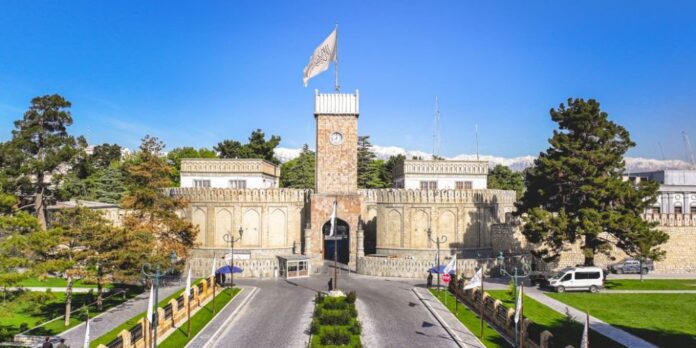
Dr. Mullah Abdul Wasi, Chief of Staff of the Prime Minister’s Office, met with a number of influential figures and elders from Nuristan province.
During the meeting, which was also attended by Sheikh Mahmood Zakiri, Director of Political and Public Affairs, a religious scholar speaking on behalf of the influential figures of Nuristan referred to the sacrifices and efforts of the province’s people during the period of jihad and stated that the residents of Nuristan support the Islamic system.
He further added that, due to the province’s difficult geographical conditions and the neglect of previous governments, the people have faced widespread deprivation.
According to him, in recent years, attacks by the Pakistani military regime have displaced residents of certain areas and further exacerbated their living conditions.
Meanwhile, during the same meeting, the influential figures of Nuristan also presented demands and proposals aimed at addressing developmental challenges, including the construction of major roads, schools, religious seminaries, and hospitals, the return of displaced residents, and the division of Kamdesh district into two separate districts.
On this occasion, Dr. Mullah Abdul Wasi, Chief of Staff of the Prime Minister’s Office, stated that the Islamic Emirate gives special attention to addressing the challenges faced by the people of all provinces of the country, particularly Nuristan, Badakhshan, Kunar, and other remote and underdeveloped areas.
He added that over the past five years, alongside development projects, new districts have also been approved in various provinces with the aim of addressing public challenges, including two districts in Nuristan province.
Furthermore, Dr. Mullah Abdul Wasi stated that, due to the wars and destruction of the past 50 years, challenges continue to exist in various sectors; however, efforts are ongoing by the authorities to resolve these issues.
In conclusion, he assured that the demands and concerns of the people of Nuristan would be shared with the relevant institutions so that the necessary measures could be taken to address them.