

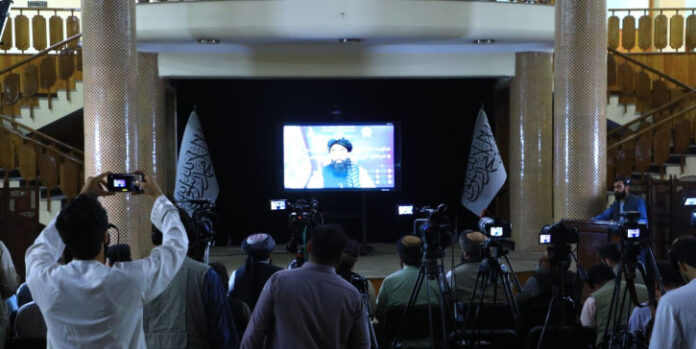
The Spokesperson of the Islamic Emirate, Mawlawi Zabihullah Mujahid, shared with the media the important achievements of the Economic and Self-Reliance Week of 1447 AH during the “Government in the Mirror of the Press” conference at the Government Information and Media Center.
According to him, important steps have been taken in the past year to strengthen the national economy, increase domestic production, and attract investment in the fields of mining, industry, trade, agriculture, transport, standards and quality, and the banking system.
Five-Year Development Strategy
According to the information provided, Afghanistan’s five-year development strategy has been approved after the approval of the Economic Commission and the approval of the leadership of the Islamic Emirate. The strategy has three main pillars and 15 priority programs that focus on good governance, rule of law, security, and economic and social development. In addition, the development budget for fiscal year 1405 has been prepared based on this strategy.
Mining Sector
More than 10 billion Afghanis have been invested in the mining and petroleum sector, 45 new mineral areas have been registered in 28 provinces, and 350 mining projects have been submitted for bidding or have received operating licenses.
In addition, 50 thousand people have been directly employed through mining contracts, and the number of job opportunities created has reached 200 thousand jobs.
Industry, Trade, and Investment
The value of Afghanistan’s total trade in the industry and trade sector has reached 13 billion and 901 million dollars, of which 1.722 billion dollars are exports and 12.178 billion dollars are imports.
In addition, 2,804 acres of land have been distributed to 576 factories, 174 new industrial companies have started operations in 16 different sectors, and $34 million in new industrial investment has been made.
To support domestic industry, 1,746,000 tons of imported raw materials and 1,329 industrial machines have been exempted from customs duties.
In the field of investment, 150 trade and investment agreements worth $2.389 billion have been signed between the private sectors of Afghanistan and regional countries.
Agriculture and Livestock
In the field of agriculture, 600 metric tons of improved wheat seeds have been distributed in 12 provinces, orchards with drip irrigation systems have been established on 1,001 acres of land, and 21,400 metric tons of wheat have been purchased from farmers.
According to information, Afghanistan produces approximately 3.9 million metric tons of milk every year, which is more than the domestic requirement.
Natural Resources
About 18.6 million saplings have been planted in natural resources, 144 hectares of destroyed pistachio forests have been restored, and hazelnut forests have been expanded to 185 hectares.
Transport
In the field of transport and aviation, 12,832 flights were operated from airports and 1,570,896 passengers were transported.
In addition, more than 46,592,000 tons of commercial goods were transported via land transport, and 60 development projects have been launched, of which 21 projects have been completed and put into operation.
Standards and Quality
So far, 1,003 national standards have been approved in the field of standards and quality. In 1447 AH, more than 104,000 samples of construction materials, 5,256 samples of electrical equipment, and hundreds of other samples have been tested. In addition, eight specialized laboratories have been activated and equipped.
Banking System
In the banking system, the value of the Afghani increased by 6.01 percent compared to the previous year, with the total amount of the Afghani reaching 409 billion Afghanis during the period, and direct and indirect employment opportunities have been provided to 141,889 people through bank financing.
According to the information of the Islamic Emirate, efforts were continuous in the past year to develop domestic production, support investment, increase exports, strengthen the agricultural and mining sectors, and create job opportunities, so that the country can progress further towards economic self-sufficiency and sustainable economic growth.