
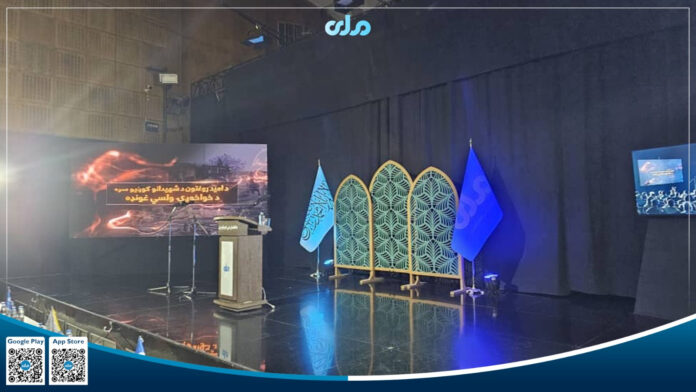
On Wednesday (April 15), a condolence gathering for the families of the victims of the “Omid” hospital was held in the conference hall of Afghanistan National Radio and Television, with the participation of a number of Islamic Emirate officials, as well as political and religious figures.
At the gathering, Qari Mohammad Yusuf Ahmadi, Director General of Afghanistan National Radio and Television, stated that the attack had ended the aspirations of those who sought to recover from drug addiction and return to a healthy life.
Similarly, Sheikh Abdul Rahman Munir, Deputy Minister for Counter-Narcotics at the Ministry of Interior, described the attack on the “Omid” hospital as a “barbaric act,” adding that it is contrary to the principles of Islam and humanity. He further called on international human rights organizations to investigate the incident in a transparent manner.
Meanwhile, Dr. Abdul Latif Nazari, Deputy Professional Minister at the Ministry of Economy, stated that the achievements of the Islamic Emirate in counter-narcotics have been recognized internationally, adding that Afghanistan’s foreign policy is based on the principles of good neighborliness.
Several other speakers also called on international human rights organizations to respond to the incident and demanded that the matter be investigated.
Political analysts Sayyid Ibadullah Sadiq and Fazl-un-Minallah Mumtaz described the incident as contrary to international principles and praised ongoing efforts in counter-narcotics.
At the conclusion of the gathering, Azizullah shared the painful account of the martyrdom of a member of his family. Likewise, religious scholar Sheikh Mohammad Faqir called on international human rights organizations not to remain silent in the face of such incidents and to fulfill their responsibilities.
The gathering was held at a time when approximately 400 people were martyred and around 250 others were injured in an attack on a 2,000-bed drug treatment hospital in Kabul by the Pakistani military regime.
The attack has drawn widespread reactions from various countries and international organizations, including the United Nations, the Organization of Islamic Cooperation of Scholars, the European Commission, UNAMA, and others.